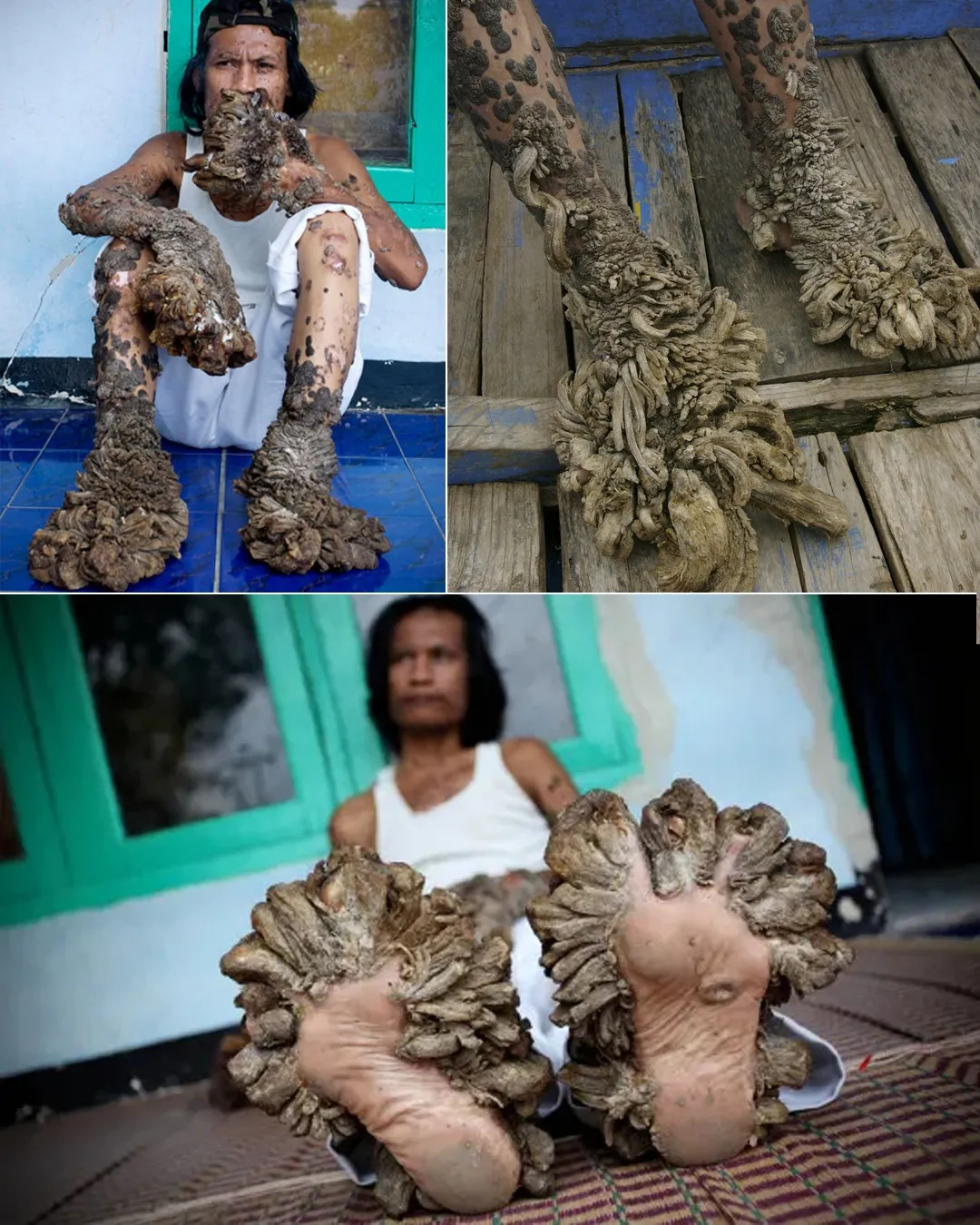
In Indonesia, Dede Koswara became known around the world by a name he never chose: “The Tree Man.”
The nickname came from the shocking appearance of bark-like growths that covered much of his body, especially his hands and feet. To millions who first saw him on television or in photographs, the condition seemed almost unreal. But behind the headlines and viral images was a man living with a rare genetic disease — and extraordinary dignity.
Dede Koswara was born in 1971 in West Java, Indonesia. As a child, his life appeared normal until a small injury at the age of ten failed to heal properly. Instead of recovering, the wound developed into unusual growths that slowly spread across his skin.
Doctors later diagnosed him with Epidermodysplasia Verruciformis (EV), an extremely rare genetic disorder that affects the body’s ability to control certain strains of the human papillomavirus (HPV). In most people, HPV causes small, common warts. In individuals with EV, however, the immune system cannot suppress the virus, allowing thick, hardened lesions to grow uncontrollably.
Over time, these growths formed dense, branch-like structures, giving his skin the appearance of tree bark. His hands and feet became so severely affected that everyday tasks — eating, walking, working — became increasingly difficult.
LEXO EDHE

Before his condition worsened, Dede worked as a carpenter and supported his family. But as the growths progressed, he lost his ability to work. The physical limitations, combined with financial hardship and social stigma, placed immense strain on his personal life. According to reports, his marriage eventually collapsed, and he became separated from his children — a loss that deeply affected him.
With few options left, Dede lived in poverty and isolation for years. At times, he earned money by appearing in public exhibitions, where people paid to see him as a medical curiosity. Though controversial, these appearances were often his only means of survival.
International attention arrived in the mid-2000s when his story was featured in documentaries by outlets such as Discovery Channel and TLC. For the first time, Dede gained access to specialized medical care.
In 2008, a team of Indonesian and international doctors performed a series of major surgeries to remove the massive growths from his body. During one operation alone, surgeons removed more than
LEXO EDHE

six kilograms (over 13 pounds) of lesions — nearly a tenth of his body weight.
The results were dramatic. For a short time, Dede regained the use of his hands and could once again perform basic tasks independently. He spoke publicly about his hopes of working again and, most importantly, holding his children with his own hands.
Because EV has no cure, the growths inevitably returned. Doctors explained that surgery could only remove existing tissue, not prevent new lesions from forming. Despite ongoing treatment, the disease continued to progress, forcing Dede to undergo repeated procedures year after year.
Throughout this ordeal, Dede rarely expressed bitterness. He did not hide from cameras or public attention, but he also rejected being treated as a spectacle. In interviews, he emphasized that he wanted to be seen as a human being — not a monster, not a medical oddity.
“I just want to live a normal life,” he once said. “To work, to support myself, and to be close to my children again.”
On January 30, 2016, Dede Koswara died at a hospital in Bandung, Indonesia. He was 44 years old. Doctors reported that he suffered from complications involving his liver and digestive system, likely worsened by years of illness and repeated surgeries.
His death marked the end of a life defined by struggle — but also by resilience.
Dede’s story continues to resonate far beyond Indonesia. It has sparked discussions about rare diseases, medical ethics, poverty, and how society treats those who look different. While images of his condition once shocked the world, his legacy is not one of fear or curiosity — but of quiet strength.
He endured pain, public scrutiny, and personal loss, yet never lost his sense of dignity. In doing so, Dede Koswara taught the world an enduring lesson: true strength does not always roar. Sometimes, it simply endures.