Arthur Vance spent most of his life believing that sacrifice was love.
For more than four decades, he worked grueling shifts at an Ohio automotive plant, trading his health for stability. He missed holidays, sold prized possessions, and postponed his own medical care so his three children could have college degrees, homes, and comfortable lives. By the time he was diagnosed with stage-four lung cancer at 73, Arthur believed he had done everything a father was supposed to do.
But when he entered hospice care, something became painfully clear: his children were gone.
For six months, Arthur waited. His phone stayed charged. The visitor’s chair stayed empty. His son David was “too busy” with corporate mergers. His daughter Sarah avoided hospitals because they “depressed” her. His youngest, Michael, communicated only through text messages asking about paperwork and property transfers.
LEXO EDHE

As Arthur lay dying, the people he had built his life around treated his final days like an inconvenience.
Then, unexpectedly, someone else showed up.
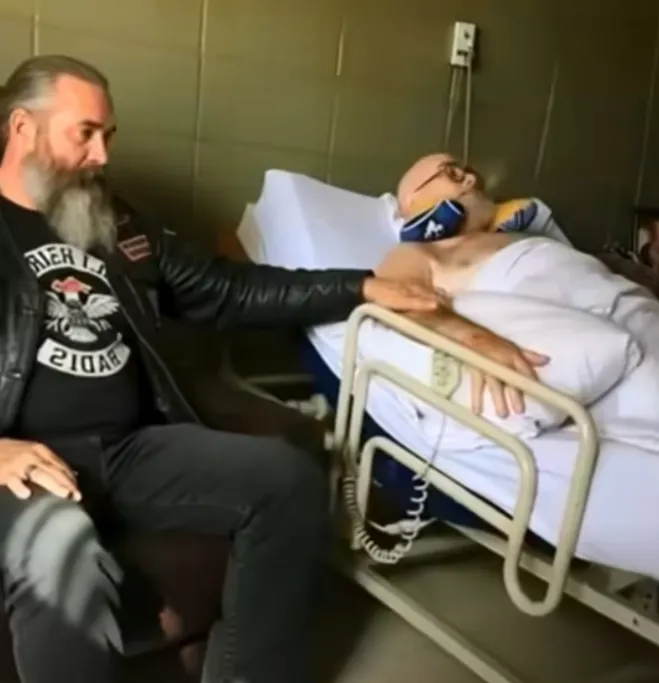
One rainy afternoon, a man named Marcus walked into Arthur’s hospice room. He was tall, broad-shouldered, dressed in worn leather, his vest covered in military patches. Marcus belonged to a motorcycle club for veterans — men bound not by blood, but by service and loyalty.
He had heard, through a nurse, that a fellow veteran was dying alone.
LEXO EDHE

Marcus sat down, noticed Arthur’s Purple Heart, and spoke to him not with pity, but with respect. He didn’t offer platitudes. He didn’t rush. He stayed.
And then he came back the next day — with others.
Soon, Arthur’s quiet room was filled with laughter, conversation, and presence. The bikers brought milkshakes, argued with nurses to improve Arthur’s pain management, and spent hours talking about engines, music, football, and war stories. They treated Arthur not like a burden, but like a brother.
For the first time in months, Arthur wasn’t alone.
During one quiet evening, Arthur showed Marcus photos of his children — successful, distant, absent. Marcus listened carefully, then said something that changed everything:
“Blood makes you relatives. Loyalty makes you family.”
With Marcus’s help, Arthur contacted a lawyer. What followed was not an act of revenge, but of clarity.
Arthur rewrote his will.

His children were formally disinherited — not forgotten, but explicitly named and excluded. His entire estate, nearly two million dollars, was placed into a trust for a veterans’ hospice and companionship fund, administered by the motorcycle club. The purpose was simple: to ensure no veteran would ever have to die alone the way Arthur almost had.
Arthur also recorded a video statement, clearly explaining his decision. He spoke calmly, lucidly, and without hatred. He said that inheritance is not an entitlement — it is a reflection of relationship. And there was none.
Arthur died a few days later, surrounded not by family, but by brothers who held his hand until the end.
At his funeral, the contrast was impossible to ignore.
His three children arrived in luxury cars, dressed in black, expecting a quiet service and an estate meeting. Instead, they found a parking lot filled with motorcycles and a chapel packed with bikers standing in silent formation.
When Marcus stood at the podium, he didn’t shout — he told the truth.
He spoke of the six months Arthur waited for his children. Of the unanswered calls. Of the excuses. Then he handed each child a letter — their only inheritance.
The letters were brief, direct, and devastating. Arthur didn’t curse them. He didn’t beg forgiveness. He simply explained why the money was gone — and who had earned the right to it.
The children left before the burial.
Arthur’s legacy, however, stayed.
The trust funded a veterans’ hospice known locally as “Artie’s Place,” a home filled with warmth, companionship, and dignity. Veterans who had been forgotten found community. No one waited alone anymore.
Arthur Vance did not leave his children wealth.
He left them a mirror.
And he left the world something far more valuable: proof that family is not defined by blood, but by who shows up when it matters most.