Orthodox Heritage in Kumanovo
Kumanovo and its surrounding villages have a rich collection of Orthodox churches, monasteries and religious monuments.
Some stand directly in the city, while others are hidden among villages and rural landscapes around Staro Nagoričane, Matejče and the wider Kumanovo region.
Together, these religious sites preserve centuries of architecture, fresco painting, iconography and local history.
For travelers interested in culture, they offer a completely different way to explore Kumanovo beyond restaurants, cafés and the main city square.
1. Church of St. Nicholas – Kumanovo
The Church of St. Nicholas is one of the most important religious landmarks in Kumanovo.
Known locally as the Old Church, it was built in 1851 in the former Varosh neighborhood.
The main architect was Andrea Damjanov, one of the best-known church builders of the nineteenth-century Balkans. kumanovomuseum.com
The building is a monumental three-nave basilica with a rectangular plan and three apses on its eastern side.
The Icon Gallery
One of the most interesting features of St. Nicholas is its Icon Gallery.
Museum Kumanovo states that the collection contains approximately 80 exhibits, with many icons dating from the nineteenth century and originating from churches around the Kumanovo region. kumanovomuseum.com
The collection also includes religious objects such as:
- Gospel covers
- Altar crosses
- Church furniture
- Liturgical objects
- Items from Karpino Monastery
For travelers interested in religious art, St. Nicholas should be one of the first churches to visit in Kumanovo.
2. Church of the Holy Trinity – Kumanovo
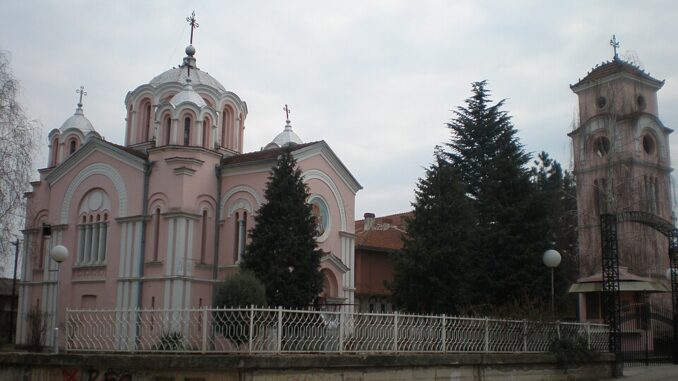
The Church of the Holy Trinity is commonly known locally as the New Church.
It was built at the beginning of the twentieth century, with Museum Kumanovo dating it to 1903. kumanovomuseum.com
The church was designed according to plans by Russian architect Vladimir Antonov and constructed by Mihajlo Gjorgjevikj from Debar.
Its architecture follows a Byzantine-inspired design with an inscribed cross and five domes.
Frescoes and Iconostasis
The frescoes date from 1904 and were painted by Krsto Avramov Dichikj.
The church also contains a wooden iconostasis produced in Constantinople in the early twentieth century. kumanovomuseum.com
Together with St. Nicholas, Holy Trinity is one of the main historic churches directly inside Kumanovo.
3. Church of St. George – Kumanovo
Kumanovo also has a Church of St. George, located near the city cemetery.
It is included among the Orthodox churches of Kumanovo in broader church listings for the Diocese of Kumanovo and Osogovo. Wikipedia
Although it does not attract the same level of tourism attention as St. Nicholas or Holy Trinity, it forms part of the city’s active Orthodox religious landscape.
Visitors should remember that churches such as this primarily serve local worshippers rather than functioning as tourist attractions.
4. Church of St. Petka – Bedinje
The Church of St. Petka is located in the Bedinje area of Kumanovo.
It is another active religious site included among the churches serving the wider city. Wikipedia
Travelers exploring neighborhoods beyond the central square may encounter smaller local churches like this one, which demonstrate that Kumanovo’s religious heritage is not limited to its two best-known historic churches.
5. Church of St. Mina – Proevce
The village of Proevce, close to Kumanovo, has the Church of St. Mina.
The church is included in church listings for the Kumanovo area and represents another example of religious life extending from the city into its neighboring settlements. Wikipedia
Proevce is also known for the nearby Kumanovo Spa area, so visitors exploring the surroundings may combine different local attractions.
6. Church of St. George – Staro Nagoričane
One of the most important medieval churches near Kumanovo is the Church of St. George in Staro Nagoričane.
The site contains elements of an older eleventh-century church and was extensively reconstructed in 1313 during the reign of King Stefan Milutin. kumanovomuseum.com
The church has five domes and an exceptionally important collection of medieval frescoes.
Famous Medieval Frescoes
Museum Kumanovo dates the major fresco cycle to 1318 and attributes the paintings to the celebrated medieval artists Michael Astrapas and Eutychios. kumanovomuseum.com
The fresco ensemble is considered among the most significant medieval wall paintings in the wider region.
For travelers interested in Byzantine and medieval art, this is one of the strongest cultural attractions near Kumanovo.
Combine Staro Nagoričane With Kokino
Staro Nagoričane can easily form part of a larger cultural day trip.
A possible route is:
Kumanovo → Staro Nagoričane → Church of St. George → Kokino → Kumanovo
This combines religious heritage with archaeology and rural scenery.
7. Karpino Monastery
The Karpino Monastery, located near the village of Suv Orah, is another important religious monument in the wider Kumanovo region.
Its church, dedicated to the Presentation of the Virgin, dates to 1592. kumanovomuseum.com
The church was painted in the same period, while another layer of painting was added during the nineteenth century.
A Historical Cultural Centre
Karpino was more than a monastery.
Museum Kumanovo describes it as an important cultural and literary centre that once possessed a rich manuscript collection.
Some manuscripts from the monastery later reached cultural centres including Belgrade, Sofia and Moscow. kumanovomuseum.com
Several historic objects from Karpino are today preserved in the Icon Gallery at St. Nicholas Church in Kumanovo.
8. St. George the Victorious – Mlado Nagoričane
The village of Mlado Nagoričane contains another important church dedicated to St. George the Victorious.
Its precise construction date is uncertain, with research placing it broadly between the fifteenth and seventeenth centuries. kumanovomuseum.com
Its architecture contains interesting influences and its decoration follows traditions connected with the better-known Church of St. George in Staro Nagoričane.
The church also preserves a nineteenth-century iconostasis.
9. Matejče Monastery
The wider cultural region also includes Matejče Monastery, located in the Lipkovo area near Kumanovo.
The monastery church is dedicated to the Dormition/Ascension of the Mother of God and dates from the medieval period.
Museum research associates its construction with the fourteenth century and notes important fresco painting from that period. kumanovomuseum.com
For visitors exploring Lipkovo, the monastery represents another layer of the region’s multicultural and religious history.
Access conditions should be checked before planning a visit.
10. Other Historic Churches Around Kumanovo
The Kumanovo region contains many smaller churches that rarely appear in international travel guides.
Museum research documents religious monuments in villages including:
- Strezovce
- Žegljane
- Dobrača
- Beljakovce
- Dovezence
- Pezovo
- Studena Bara
- Dejlovce
- Proevce
- Matejče
- Režanovce
Some date to the sixteenth and seventeenth centuries, while others were constructed or rebuilt later. kumanovomuseum.com
This makes the wider Kumanovo countryside surprisingly rich for travelers interested in churches and religious architecture.
Churches With Oriental Architectural Influences
One particularly interesting feature of the region is the interaction between different architectural traditions.
Research from Museum Kumanovo highlights a group of post-Byzantine churches that show certain Oriental architectural influences, including churches in Mlado Nagoričane, Strezovce, Dobrača, Suv Orah and Žegljane. kumanovomuseum.com
These details reflect the complex cultural environment in which Christian and Islamic architecture developed side by side during the Ottoman period.
Visiting Orthodox Churches Respectfully
Most churches in Kumanovo are active religious sites.
Visitors should:
- Dress respectfully
- Keep voices low
- Avoid interrupting religious services
- Ask before photographing worshippers
- Avoid touching icons or frescoes
- Check whether interior photography is permitted
- Follow instructions from clergy or caretakers
Some rural churches may not remain permanently open during the day.
Best Churches for First-Time Visitors
If you have limited time, start with:
St. Nicholas – Kumanovo
Best for nineteenth-century architecture and the Icon Gallery.
Holy Trinity – Kumanovo
Best for early twentieth-century architecture.
St. George – Staro Nagoričane
Best for medieval frescoes and history.
Karpino Monastery
Best for a more remote monastery experience.
One-Day Church & Heritage Route
Visitors with a car can create a cultural itinerary such as:
Morning: St. Nicholas Church in Kumanovo
Then: Holy Trinity Church
Lunch: Kumanovo city centre
Afternoon: Staro Nagoričane and St. George
Later: Kokino, if daylight and weather allow
This route combines several centuries of history within one day.
More Than Religious Buildings
The churches of Kumanovo are important not only because of religion.
They preserve:
- Medieval frescoes
- Historic icons
- Traditional architecture
- Religious manuscripts
- Local craftsmanship
- Evidence of centuries of cultural change
Together with Kumanovo’s mosques, museums and archaeological sites, they help explain the diverse cultural history of northeastern North Macedonia.
Be the first to comment