Introduction
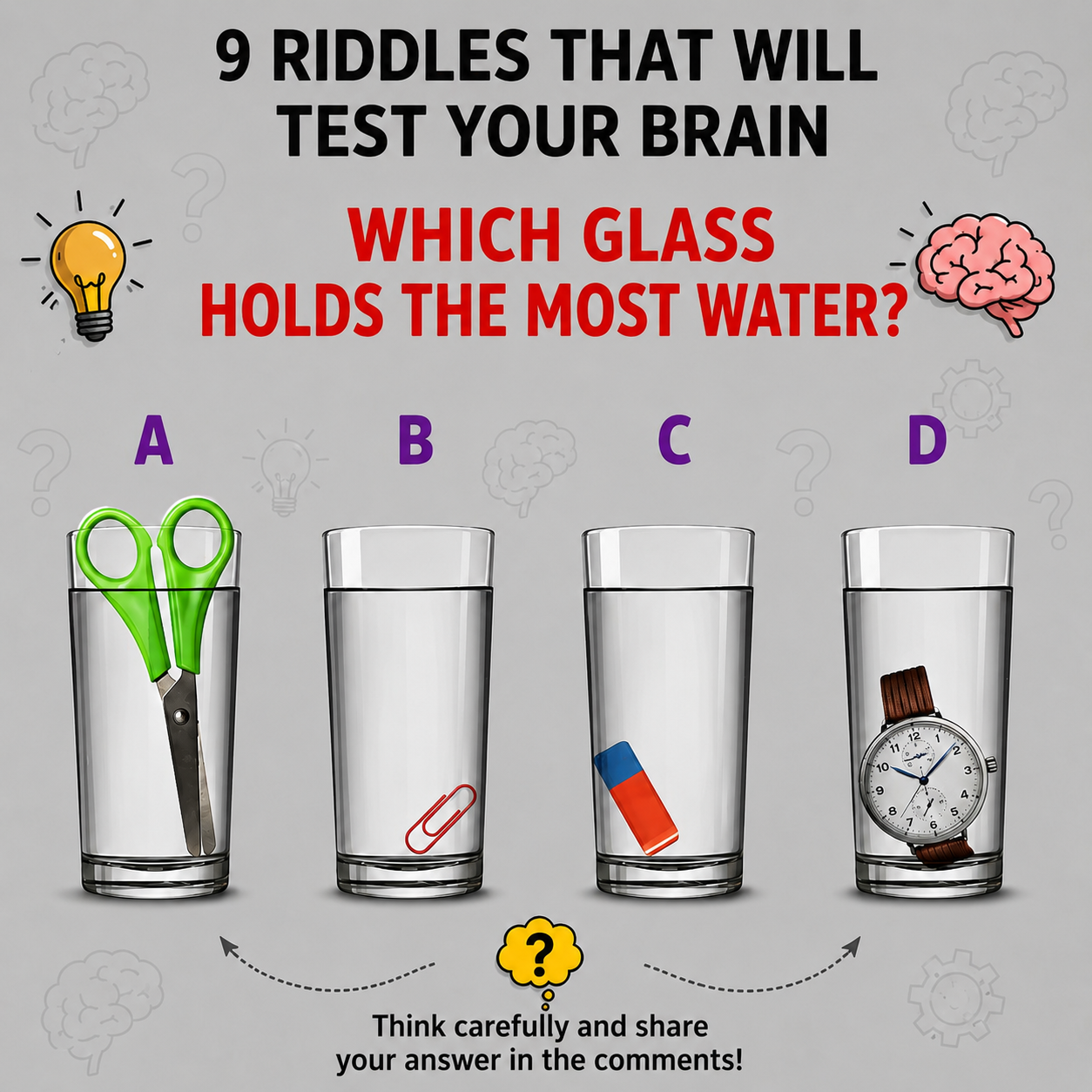
At first glance, this puzzle looks incredibly simple: four glasses labeled A, B, C, and D appear to be filled to the same level with water. Inside each glass is a different object—a pair of scissors, a paper clip, an eraser, and a pocket watch.
The challenge asks a seemingly straightforward question:
Which glass contains the most water?
Many people immediately focus on the size of the glasses or the objects inside them. However, puzzles like this are designed to test observation skills and logical thinking rather than advanced knowledge. The answer often depends on noticing a detail that is easy to overlook.
Understanding the Puzzle
All four glasses appear to be filled to approximately the same height. The key difference is the object placed inside each one:
Glass A contains a pair of scissors.
Glass B contains a small paper clip.
Glass C contains an eraser.
Glass D contains a pocket watch.
When an object is placed into water, it displaces some of the liquid. In simple terms, the object takes up space that water would otherwise occupy.
This means that if all four glasses are filled to the same visible level, the glass containing the smallest object will generally hold the greatest amount of actual water.
The Science Behind the Riddle
This puzzle is based on a basic principle of physics known as displacement.
When an object is submerged in a liquid, it pushes aside an amount of liquid equal to the volume of the object below the surface. Larger objects displace more water, while smaller objects displace less.
Imagine filling four identical containers to the same height:
A large object inside one container reduces the amount of water needed to reach that level.
A tiny object inside another container leaves more room for water.
Because the paper clip in Glass B occupies the least space, it displaces the smallest amount of water.
The Likely Answer
Using the displacement principle, Glass B is the most likely correct answer because the paper clip takes up far less volume than the scissors, eraser, or pocket watch.
As a result, Glass B contains the greatest quantity of water even though the visible water level appears similar across all four glasses.
Why Puzzles Like This Are Good for Your Brain
Brain teasers are more than just entertainment. They encourage people to:
Improve Attention to Detail
Many individuals focus on the most noticeable objects—in this case, the large scissors or watch—while overlooking the importance of volume and displacement.
Practice Logical Reasoning
Rather than relying on intuition alone, puzzles encourage step-by-step thinking and analysis.
Strengthen Problem-Solving Skills
Challenges that require looking beyond the obvious can help develop flexible thinking, which is useful in everyday decision-making.
Encourage Scientific Curiosity
Simple riddles often introduce scientific concepts in an engaging way. In this puzzle, participants unknowingly apply principles of physics to reach the answer.
Common Mistakes People Make
One reason this puzzle has become popular online is that many people answer too quickly. Some common mistakes include:
Assuming all glasses contain exactly the same amount of water.
Judging based on object weight rather than object volume.
Focusing on the largest visible object instead of the amount of space it occupies.
Ignoring the fact that submerged objects affect water levels.
These errors demonstrate how easily our brains can rely on visual impressions instead of careful analysis.
Conclusion
The “Which Glass Holds the Most Water?” puzzle is a great example of how a simple image can challenge our observation skills and understanding of basic science. While all four glasses appear nearly identical, the objects inside them make an important difference.
By applying the concept of water displacement, the most reasonable answer is Glass B, since the paper clip occupies the least space and therefore leaves the most room for water.
Whether you solved it immediately or had to think it through, puzzles like this remind us that the smallest details can sometimes make the biggest difference.